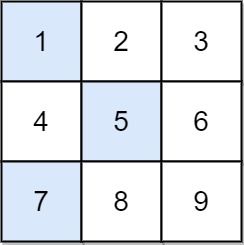
Given an n x n integer matrix grid, return the minimum sum of a falling path with non-zero shifts.
A falling path with non-zero shifts is a choice of exactly one element from each row of grid such that no two elements chosen in adjacent rows are in the same column.
Example 1:
Input: grid = [[1,2,3],[4,5,6],[7,8,9]]
Output: 13
Explanation:
The possible falling paths are:
[1,5,9], [1,5,7], [1,6,7], [1,6,8],
[2,4,8], [2,4,9], [2,6,7], [2,6,8],
[3,4,8], [3,4,9], [3,5,7], [3,5,9]
The falling path with the smallest sum is [1,5,7], so the answer is 13.
Example 2:
Input: grid = [[7]]
Output: 7
Constraints:
n == grid.length == grid[i].length
1 <= n <= 200
-99 <= grid[i][j] <= 99
Solutions
Solution 1: Dynamic Programming (Rolling Array)
Thinking
A falling path cannot reuse a column on the next row. \(n \le 200\) allows \(O(n^3)\). The best way to end row \(i\) in column \(j\) is the previous row's minimum excluding \(j\), plus \(grid[i][j]\).
We keep only the previous \(n\) values and add “min except this column” in place. A rolling array drops the row dimension.
Let \(f[i][j]\) be the minimum path sum using the first \(i\) rows and ending in column \(j\):