1256. Encode Number 🔒



Description
Given a non-negative integer num, Return its encoding string.
The encoding is done by converting the integer to a string using a secret function that you should deduce from the following table:
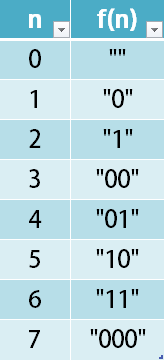
Example 1:
Input: num = 23
Output: "1000"
Example 2:
Input: num = 107
Output: "101100"
Constraints:
0 <= num <= 10^9
Solutions
Solution 1: Bit Manipulation
Thinking
The table is \(0,1,00,01,\ldots\), i.e. all binary strings in order. The bits of \(num+1\) without the leading \(1\) are exactly the \(num\)-th such string. \(num\) reaches \(10^9\), so we cannot list them; one bit trick suffices.
We add one to \(num\), then convert it to a binary string and remove the highest bit \(1\).
The time complexity is \(O(\log n)\), and the space complexity is \(O(\log n)\). Where \(n\) is the size of \(num\).
1 2 3 | |
1 2 3 4 5 | |
1 2 3 4 5 6 7 8 9 10 11 12 | |
1 2 3 4 5 | |
1 2 3 4 5 | |