1252. Cells with Odd Values in a Matrix



Description
There is an m x n matrix that is initialized to all 0's. There is also a 2D array indices where each indices[i] = [ri, ci] represents a 0-indexed location to perform some increment operations on the matrix.
For each location indices[i], do both of the following:
- Increment all the cells on row
ri. - Increment all the cells on column
ci.
Given m, n, and indices, return the number of odd-valued cells in the matrix after applying the increment to all locations in indices.
Example 1:

Input: m = 2, n = 3, indices = [[0,1],[1,1]]
Output: 6
Explanation: Initial matrix = [[0,0,0],[0,0,0]].
After applying first increment it becomes [[1,2,1],[0,1,0]].
The final matrix is [[1,3,1],[1,3,1]], which contains 6 odd numbers.
Example 2:
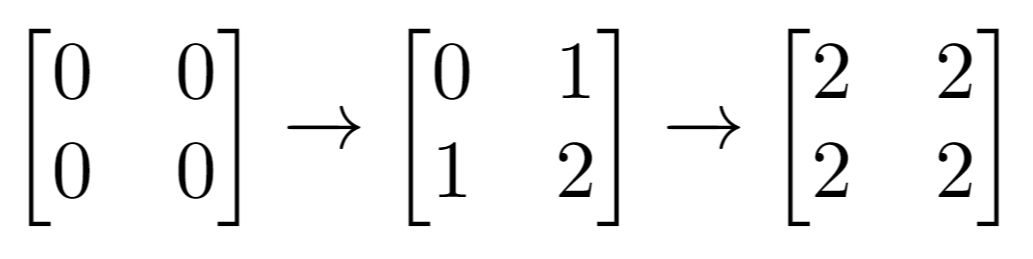
Input: m = 2, n = 2, indices = [[1,1],[0,0]]
Output: 0
Explanation: Final matrix = [[2,2],[2,2]]. There are no odd numbers in the final matrix.
Constraints:
1 <= m, n <= 501 <= indices.length <= 1000 <= ri < m0 <= ci < n
Follow up: Could you solve this in O(n + m + indices.length) time with only O(n + m) extra space?
Solutions
Solution 1: Simulation
Thinking
With \(m,n \le 50\) we may allocate the matrix, add one to a whole row and column per operation, then count odds. The simulation follows the statement and is the baseline for later optimizations.
We create a matrix \(g\) to store the result of operations. For each pair \((r_i, c_i)\) in \(\textit{indices}\), we add \(1\) to all numbers in the \(r_i\)-th row of the matrix and add \(1\) to all elements in the \(c_i\)-th column.
After the simulation ends, we traverse the matrix and count the number of odd numbers.
The time complexity is \(O(k \times (m + n) + m \times n)\), and the space complexity is \(O(m \times n)\). Here, \(k\) is the length of \(\textit{indices}\).
1 2 3 4 5 6 7 8 9 | |
1 2 3 4 5 6 7 8 9 10 11 12 13 14 15 16 17 18 19 20 21 | |
1 2 3 4 5 6 7 8 9 10 11 12 13 14 15 16 17 18 19 20 21 22 | |
1 2 3 4 5 6 7 8 9 10 11 12 13 14 15 16 17 18 19 20 21 22 | |
Solution 2: Space Optimization
Thinking
Solution 1 writes \(O(m+n)\) cells per operation and stores the full matrix. Cell \((i,j)\) ends at (row-\(i\) hits) plus (column-\(j\) hits). Two arrays store those increments; we then test each cell's parity. Extra space is \(O(m+n)\).
We can use a row array \(\textit{row}\) and a column array \(\textit{col}\) to record the number of times each row and column is incremented. For each pair \((r_i, c_i)\) in \(\textit{indices}\), we add \(1\) to \(\textit{row}[r_i]\) and \(\textit{col}[c_i]\) respectively.
After the operations are completed, the count at position \((i, j)\) can be calculated as \(\textit{row}[i] + \textit{col}[j]\). We traverse the matrix and count the number of odd numbers.
The time complexity is \(O(k + m \times n)\), and the space complexity is \(O(m + n)\). Here, \(k\) is the length of \(\textit{indices}\).
1 2 3 4 5 6 7 8 | |
1 2 3 4 5 6 7 8 9 10 11 12 13 14 15 16 17 18 | |
1 2 3 4 5 6 7 8 9 10 11 12 13 14 15 16 17 18 19 | |
1 2 3 4 5 6 7 8 9 10 11 12 13 14 15 16 | |
Solution 3: Mathematical Optimization
Thinking
Solution 2 still visits every cell. \((i,j)\) is odd iff the row and column increments have opposite parity. With \(cnt1\) odd rows and \(cnt2\) odd columns, the odd count is \(cnt1(n-cnt2)+cnt2(m-cnt1)\), in \(O(k+m+n)\) time.
We notice that a number at position \((i, j)\) in the matrix will be odd only when exactly one of \(\textit{row}[i]\) and \(\textit{col}[j]\) is odd and the other is even.
We count the number of odd numbers in \(\textit{row}\), denoted as \(\textit{cnt1}\), and the number of odd numbers in \(\textit{col}\), denoted as \(\textit{cnt2}\). Therefore, the final count of odd numbers is \(\textit{cnt1} \times (n - \textit{cnt2}) + \textit{cnt2} \times (m - \textit{cnt1})\).
The time complexity is \(O(k + m + n)\), and the space complexity is \(O(m + n)\). Here, \(k\) is the length of \(\textit{indices}\).
1 2 3 4 5 6 7 8 9 10 | |
1 2 3 4 5 6 7 8 9 10 11 12 13 14 15 16 17 18 19 | |
1 2 3 4 5 6 7 8 9 10 11 12 13 14 15 16 17 18 19 20 | |
1 2 3 4 5 6 7 8 9 10 11 12 13 14 15 16 17 | |