1222. Queens That Can Attack the King



Description
On a 0-indexed 8 x 8 chessboard, there can be multiple black queens and one white king.
You are given a 2D integer array queens where queens[i] = [xQueeni, yQueeni] represents the position of the ith black queen on the chessboard. You are also given an integer array king of length 2 where king = [xKing, yKing] represents the position of the white king.
Return the coordinates of the black queens that can directly attack the king. You may return the answer in any order.
Example 1:
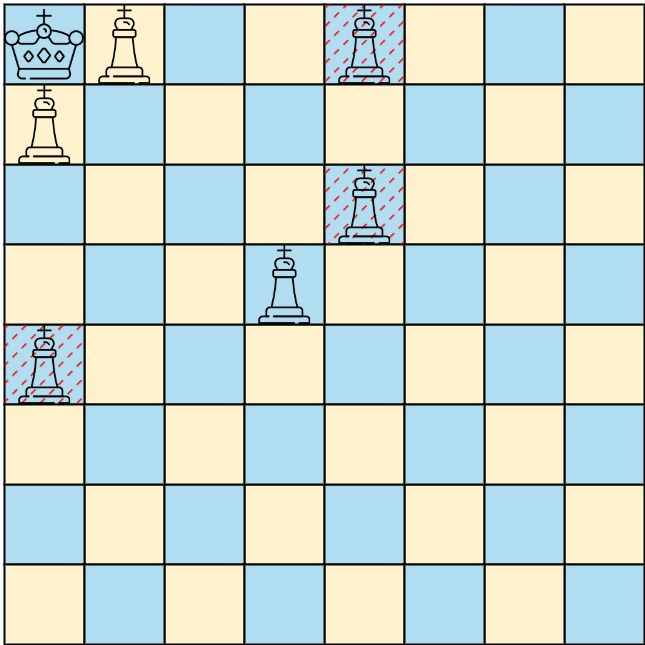
Input: queens = [[0,1],[1,0],[4,0],[0,4],[3,3],[2,4]], king = [0,0]
Output: [[0,1],[1,0],[3,3]]
Explanation: The diagram above shows the three queens that can directly attack the king and the three queens that cannot attack the king (i.e., marked with red dashes).
Example 2:
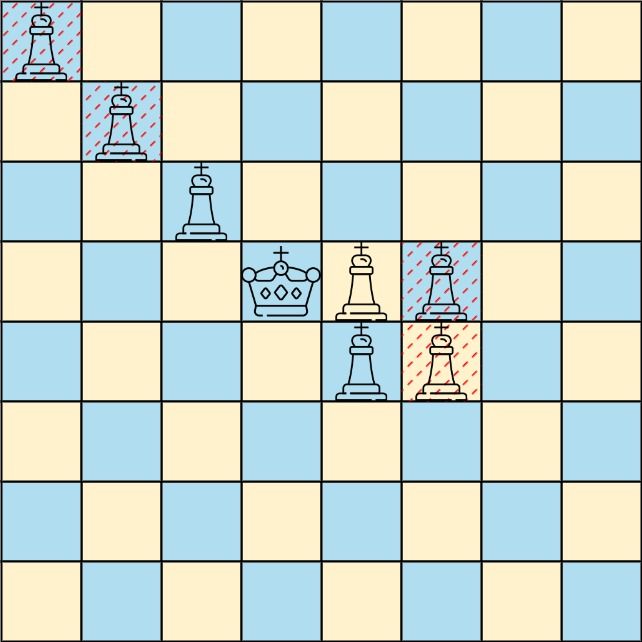
Input: queens = [[0,0],[1,1],[2,2],[3,4],[3,5],[4,4],[4,5]], king = [3,3]
Output: [[2,2],[3,4],[4,4]]
Explanation: The diagram above shows the three queens that can directly attack the king and the three queens that cannot attack the king (i.e., marked with red dashes).
Constraints:
1 <= queens.length < 64queens[i].length == king.length == 20 <= xQueeni, yQueeni, xKing, yKing < 8- All the given positions are unique.
Solutions
Solution 1: Direct Search
Thinking
The board is \(8\times 8\) with fewer than \(64\) queens. A queen attacks the king only on the same row, column, or diagonal, with no queen in between. Walking outward from the king, the first queen on each of the eight rays is the unique attacker on that ray.
We store queen cells in a set for \(O(1)\) tests, then step from the king along the eight unit vectors, recording a hit and stopping that ray. The walk encodes blocking; the set keeps each step constant-time.
First, we store all the positions of the queens in a hash table or a two-dimensional array \(s\).
Next, starting from the position of the king, we search in the eight directions: up, down, left, right, upper left, upper right, lower left, and lower right. If there is a queen in a certain direction, we add its position to the answer and stop continuing to search in that direction.
After the search is over, we return the answer.
The time complexity is \(O(n^2)\), and the space complexity is \(O(n^2)\). In this problem, \(n = 8\).
1 2 3 4 5 6 7 8 9 10 11 12 13 14 15 16 17 | |
1 2 3 4 5 6 7 8 9 10 11 12 13 14 15 16 17 18 19 20 21 22 23 24 25 26 | |
1 2 3 4 5 6 7 8 9 10 11 12 13 14 15 16 17 18 19 20 21 22 23 24 25 26 27 | |
1 2 3 4 5 6 7 8 9 10 11 12 13 14 15 16 17 18 19 20 21 22 23 | |
1 2 3 4 5 6 7 8 9 10 11 12 13 14 15 16 17 18 19 20 21 22 | |