Array Breadth-First Search Matrix
Description Given an n x n binary matrix grid, return the length of the shortest clear path in the matrix . If there is no clear path, return -1.
A clear path in a binary matrix is a path from the top-left cell (i.e., (0, 0)) to the bottom-right cell (i.e., (n - 1, n - 1)) such that:
All the visited cells of the path are 0. All the adjacent cells of the path are 8-directionally connected (i.e., they are different and they share an edge or a corner). The length of a clear path is the number of visited cells of this path.
Example 1:
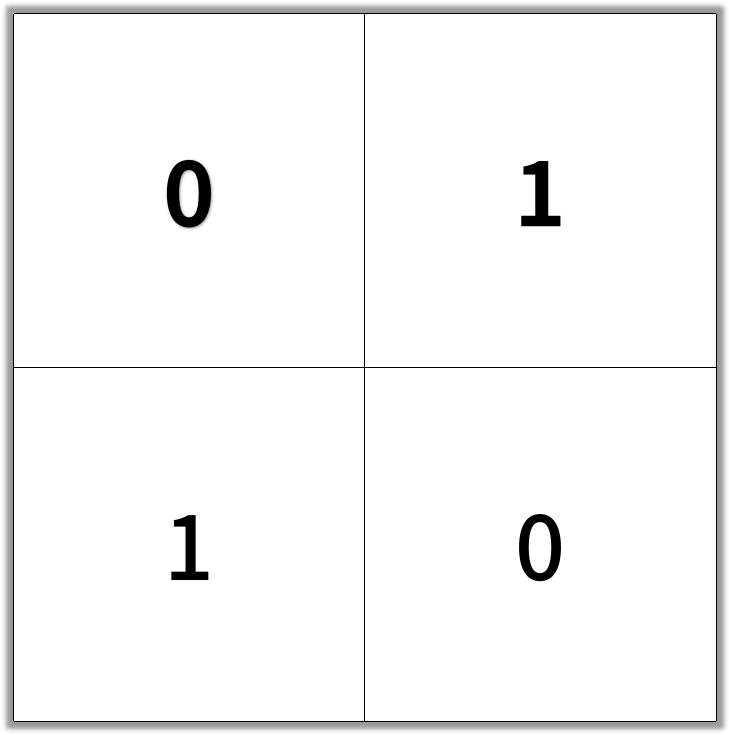
Input: grid = [[0,1],[1,0]]
Output: 2
Example 2:
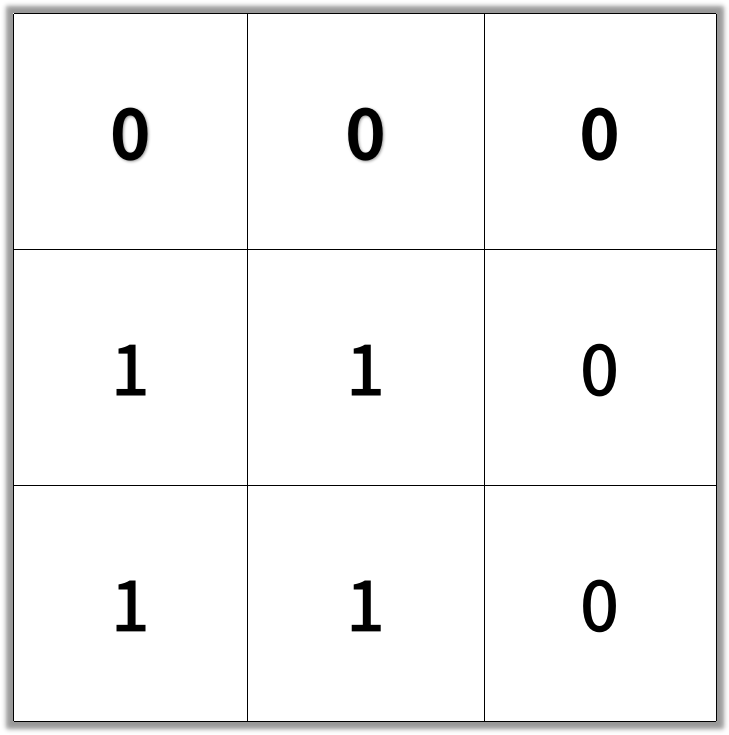
Input: grid = [[0,0,0],[1,1,0],[1,1,0]]
Output: 4
Example 3:
Input: grid = [[1,0,0],[1,1,0],[1,1,0]]
Output: -1
Constraints:
n == grid.lengthn == grid[i].length1 <= n <= 100grid[i][j] is 0 or 1 Solutions Solution 1 Thinking
The eight-connected path has unit weights, so BFS by layer is the shortest length. \(n\le 100\) lets us mark visited cells in the grid. A blocked origin has no path.
Enqueue \((0,0)\) and mark it \(1\) . Each layer expands the eight neighbors that are still \(0\) . Reaching \((n-1,n-1)\) yields the current layer index.
If the queue empties first, the answer is \(-1\) .
Python3 Java C++ Go TypeScript Rust
 1
 2
 3
 4
 5
 6
 7
 8
 9
10
11
12
13
14
15
16
17
18
19
20
class Solution :
def shortestPathBinaryMatrix ( self , grid : List [ List [ int ]]) -> int :
if grid [ 0 ][ 0 ]:
return - 1
n = len ( grid )
grid [ 0 ][ 0 ] = 1
q = deque ([( 0 , 0 )])
ans = 1
while q :
for _ in range ( len ( q )):
i , j = q . popleft ()
if i == j == n - 1 :
return ans
for x in range ( i - 1 , i + 2 ):
for y in range ( j - 1 , j + 2 ):
if 0 <= x < n and 0 <= y < n and grid [ x ][ y ] == 0 :
grid [ x ][ y ] = 1
q . append (( x , y ))
ans += 1
return - 1
 1
 2
 3
 4
 5
 6
 7
 8
 9
10
11
12
13
14
15
16
17
18
19
20
21
22
23
24
25
26
27
28
29
class Solution {
public int shortestPathBinaryMatrix ( int [][] grid ) {
if ( grid [ 0 ][ 0 ] == 1 ) {
return - 1 ;
}
int n = grid . length ;
grid [ 0 ][ 0 ] = 1 ;
Deque < int []> q = new ArrayDeque <> ();
q . offer ( new int [] { 0 , 0 });
for ( int ans = 1 ; ! q . isEmpty (); ++ ans ) {
for ( int k = q . size (); k > 0 ; -- k ) {
var p = q . poll ();
int i = p [ 0 ] , j = p [ 1 ] ;
if ( i == n - 1 && j == n - 1 ) {
return ans ;
}
for ( int x = i - 1 ; x <= i + 1 ; ++ x ) {
for ( int y = j - 1 ; y <= j + 1 ; ++ y ) {
if ( x >= 0 && x < n && y >= 0 && y < n && grid [ x ][ y ] == 0 ) {
grid [ x ][ y ] = 1 ;
q . offer ( new int [] { x , y });
}
}
}
}
}
return - 1 ;
}
}
 1
 2
 3
 4
 5
 6
 7
 8
 9
10
11
12
13
14
15
16
17
18
19
20
21
22
23
24
25
26
27
28
29
30
class Solution {
public :
int shortestPathBinaryMatrix ( vector < vector < int >>& grid ) {
if ( grid [ 0 ][ 0 ]) {
return -1 ;
}
int n = grid . size ();
grid [ 0 ][ 0 ] = 1 ;
queue < pair < int , int >> q ;
q . emplace ( 0 , 0 );
for ( int ans = 1 ; ! q . empty (); ++ ans ) {
for ( int k = q . size (); k ; -- k ) {
auto [ i , j ] = q . front ();
q . pop ();
if ( i == n - 1 && j == n - 1 ) {
return ans ;
}
for ( int x = i - 1 ; x <= i + 1 ; ++ x ) {
for ( int y = j - 1 ; y <= j + 1 ; ++ y ) {
if ( x >= 0 && x < n && y >= 0 && y < n && ! grid [ x ][ y ]) {
grid [ x ][ y ] = 1 ;
q . emplace ( x , y );
}
}
}
}
}
return -1 ;
}
};
 1
 2
 3
 4
 5
 6
 7
 8
 9
10
11
12
13
14
15
16
17
18
19
20
21
22
23
24
25
26
27
func shortestPathBinaryMatrix ( grid [][] int ) int {
if grid [ 0 ][ 0 ] == 1 {
return - 1
}
n := len ( grid )
grid [ 0 ][ 0 ] = 1
q := [][ 2 ] int {{ 0 , 0 }}
for ans := 1 ; len ( q ) > 0 ; ans ++ {
for k := len ( q ); k > 0 ; k -- {
p := q [ 0 ]
i , j := p [ 0 ], p [ 1 ]
q = q [ 1 :]
if i == n - 1 && j == n - 1 {
return ans
}
for x := i - 1 ; x <= i + 1 ; x ++ {
for y := j - 1 ; y <= j + 1 ; y ++ {
if x >= 0 && x < n && y >= 0 && y < n && grid [ x ][ y ] == 0 {
grid [ x ][ y ] = 1
q = append ( q , [ 2 ] int { x , y })
}
}
}
}
}
return - 1
}
 1
 2
 3
 4
 5
 6
 7
 8
 9
10
11
12
13
14
15
16
17
18
19
20
21
22
23
24
25
26
function shortestPathBinaryMatrix ( grid : number [][]) : number {
if ( grid [ 0 ][ 0 ]) {
return - 1 ;
}
const max = grid . length - 1 ;
grid [ 0 ][ 0 ] = 1 ;
let q : number [][] = [[ 0 , 0 ]];
for ( let ans = 1 ; q . length > 0 ; ++ ans ) {
const nq : number [][] = [];
for ( const [ i , j ] of q ) {
if ( i === max && j === max ) {
return ans ;
}
for ( let x = i - 1 ; x <= i + 1 ; ++ x ) {
for ( let y = j - 1 ; y <= j + 1 ; ++ y ) {
if ( grid [ x ] ? .[ y ] === 0 ) {
grid [ x ][ y ] = 1 ;
nq . push ([ x , y ]);
}
}
}
}
q = nq ;
}
return - 1 ;
}
 1
 2
 3
 4
 5
 6
 7
 8
 9
10
11
12
13
14
15
16
17
18
19
20
21
22
23
24
25
26
27
28
29
30
31
32
33
use std :: collections :: VecDeque ;
impl Solution {
pub fn shortest_path_binary_matrix ( mut grid : Vec < Vec < i32 >> ) -> i32 {
let n = grid . len ();
let mut queue = VecDeque :: new ();
queue . push_back ([ 0 , 0 ]);
let mut res = 0 ;
while ! queue . is_empty () {
res += 1 ;
for _ in 0 .. queue . len () {
let [ i , j ] = queue . pop_front (). unwrap ();
if grid [ i ][ j ] == 1 {
continue ;
}
if i == n - 1 && j == n - 1 {
return res ;
}
grid [ i ][ j ] = 1 ;
for x in - 1 ..= 1 {
for y in - 1 ..= 1 {
let x = x + ( i as i32 );
let y = y + ( j as i32 );
if x < 0 || x == ( n as i32 ) || y < 0 || y == ( n as i32 ) {
continue ;
}
queue . push_back ([ x as usize , y as usize ]);
}
}
}
}
- 1
}
}