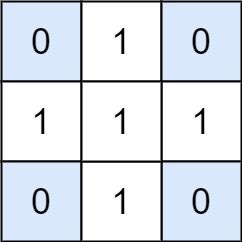
Given a matrix and a target, return the number of non-empty submatrices that sum to target.
A submatrix x1, y1, x2, y2 is the set of all cells matrix[x][y] with x1 <= x <= x2 and y1 <= y <= y2.
Two submatrices (x1, y1, x2, y2) and (x1', y1', x2', y2') are different if they have some coordinate that is different: for example, if x1 != x1'.
Example 1:
Input: matrix = [[0,1,0],[1,1,1],[0,1,0]], target = 0
Output: 4
Explanation: The four 1x1 submatrices that only contain 0.
Example 2:
Input: matrix = [[1,-1],[-1,1]], target = 0
Output: 5
Explanation: The two 1x2 submatrices, plus the two 2x1 submatrices, plus the 2x2 submatrix.
Example 3:
Input: matrix = [[904]], target = 0
Output: 0
Constraints:
1 <= matrix.length <= 100
1 <= matrix[0].length <= 100
-1000 <= matrix[i][j] <= 1000
-10^8 <= target <= 10^8
Solutions
Solution 1
Thinking
Four nested loops over a \(100\times 100\) matrix are \(O(n^4)\). Fixing the top and bottom rows compresses each column to a sum, leaving “subarrays that add to \(\textit{target}\)” on a 1-D array.
That 1-D count uses a prefix-sum map: after adding \(x\), look up \(s-\textit{target}\). There are \(O(n^2)\) row pairs and a linear scan per pair.
Sum \(f(\textit{col})\) over every pair of bounds.