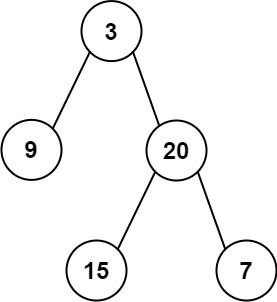
Given two integer arrays preorder and inorder where preorder is the preorder traversal of a binary tree and inorder is the inorder traversal of the same tree, construct and return the binary tree.
preorder is guaranteed to be the preorder traversal of the tree.
inorder is guaranteed to be the inorder traversal of the tree.
Solutions
Solution 1: Hash Table + Recursion
Thinking
Preorder gives the root order; inorder splits each root into left and right subtrees. Scanning inorder for the root every time can cost \(O(n^2)\); \(n \le 3000\) is tight.
Values are unique, so we map each inorder value to its index once. The first value of the current preorder slice is the root; everything left of it in inorder is the left subtree, the rest the right. Those lengths fix the next two recursive slices.
The first node \(preorder[0]\) in the pre-order sequence is the root node. We find the position \(k\) of the root node in the in-order sequence, which can divide the in-order sequence into the left subtree \(inorder[0..k]\) and the right subtree \(inorder[k+1..]\).
Through the intervals of the left and right subtrees, we can calculate the number of nodes in the left and right subtrees, assumed to be \(a\) and \(b\). Then in the pre-order nodes, the \(a\) nodes after the root node are the left subtree, and the \(b\) nodes after that are the right subtree.
Therefore, we design a function \(dfs(i, j, n)\), where \(i\) and \(j\) represent the starting positions of the pre-order sequence and the in-order sequence, respectively, and \(n\) represents the number of nodes. The return value of the function is the binary tree constructed with \(preorder[i..i+n-1]\) as the pre-order sequence and \(inorder[j..j+n-1]\) as the in-order sequence.
The execution process of the function \(dfs(i, j, n)\) is as follows:
If \(n \leq 0\), it means there are no nodes, return a null node.
Take out the first node \(v = preorder[i]\) of the pre-order sequence as the root node, and then use the hash table \(d\) to find the position \(k\) of the root node in the in-order sequence. Then the number of nodes in the left subtree is \(k - j\), and the number of nodes in the right subtree is \(n - k + j - 1\).
Recursively construct the left subtree \(l = dfs(i + 1, j, k - j)\) and the right subtree \(r = dfs(i + 1 + k - j, k + 1, n - k + j - 1)\).
Finally, return the binary tree with \(v\) as the root node and \(l\) and \(r\) as the left and right subtrees, respectively.
The time complexity is \(O(n)\), and the space complexity is \(O(n)\). Here, \(n\) is the number of nodes in the binary tree.
1 2 3 4 5 6 7 8 910111213141516171819
# Definition for a binary tree node.# class TreeNode:# def __init__(self, val=0, left=None, right=None):# self.val = val# self.left = left# self.right = rightclassSolution:defbuildTree(self,preorder:List[int],inorder:List[int])->Optional[TreeNode]:defdfs(i:int,j:int,n:int)->Optional[TreeNode]:ifn<=0:returnNonev=preorder[i]k=d[v]l=dfs(i+1,j,k-j)r=dfs(i+1+k-j,k+1,n-k+j-1)returnTreeNode(v,l,r)d={v:ifori,vinenumerate(inorder)}returndfs(0,0,len(preorder))
/** * Definition for a binary tree node. * type TreeNode struct { * Val int * Left *TreeNode * Right *TreeNode * } */funcbuildTree(preorder[]int,inorder[]int)*TreeNode{d:=map[int]int{}fori,x:=rangeinorder{d[x]=i}vardfsfunc(i,j,nint)*TreeNodedfs=func(i,j,nint)*TreeNode{ifn<=0{returnnil}v:=preorder[i]k:=d[v]l:=dfs(i+1,j,k-j)r:=dfs(i+1+k-j,k+1,n-1-(k-j))return&TreeNode{v,l,r}}returndfs(0,0,len(preorder))}
Solution 1 needs unique values so one index locates the root. If values may repeat, a value can have several legal inorder positions. We store every index, try each one that falls in the current interval, recurse on both sides, and take the Cartesian product. This problem does not need that branch; it shows how to enumerate every feasible tree when duplicates are allowed.
This problem guarantees that node values are unique. If duplicates are allowed, the hash table should store every index of each value, and we enumerate every possible root position in the current range to build all valid binary trees.
The time and space complexities both depend on the number of valid trees (we build and store all of them) and are exponential in the worst case. The recursion stack uses \(O(n)\) extra space.