Skip to content

1028. Recover a Tree From Preorder Traversal

Description

We run a preorder depth-first search (DFS) on the root of a binary tree.

At each node in this traversal, we output D dashes (where D is the depth of this node), then we output the value of this node.  If the depth of a node is D, the depth of its immediate child is D + 1.  The depth of the root node is 0.

If a node has only one child, that child is guaranteed to be the left child.

Given the output traversal of this traversal, recover the tree and return its root.


Example 1:
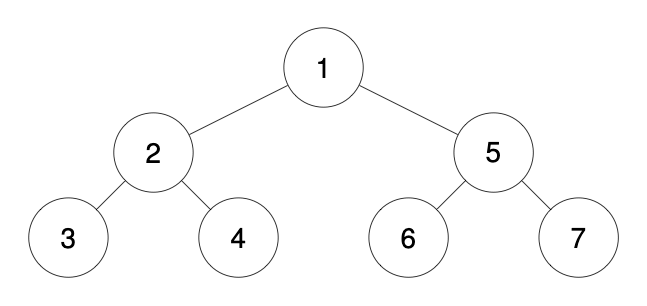
Input: traversal = "1-2--3--4-5--6--7"
Output: [1,2,5,3,4,6,7]

Example 2:
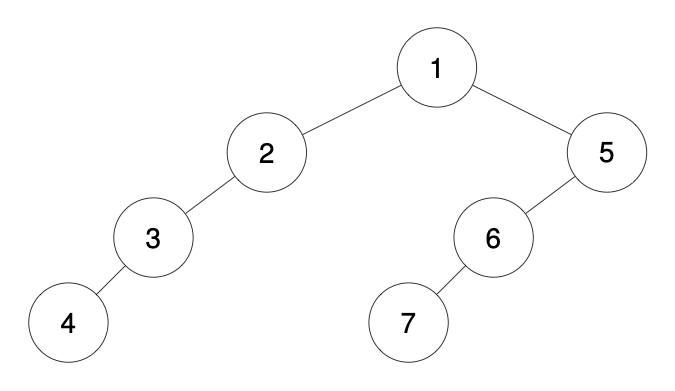
Input: traversal = "1-2--3---4-5--6---7"
Output: [1,2,5,3,null,6,null,4,null,7]

Example 3:
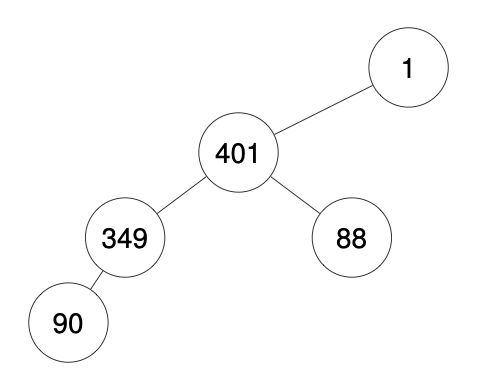
Input: traversal = "1-401--349---90--88"
Output: [1,401,null,349,88,90]


Constraints:

  • The number of nodes in the original tree is in the range [1, 1000].
  • 1 <= Node.val <= 109

Solutions

Solution 1

Thinking

Splitting the traversal by depth and recursively attaching children builds the tree for \(n\le 1000\), but the string is carved many times. In a depth-annotated preorder the parent of a new node is the nearest node whose depth is one smaller — the stack top after popping deeper nodes.

We parse runs of - as depth and digits as values. Before pushing, nodes whose depth is not smaller are popped; the new node becomes the left or right child of the new top.

The bottom of the stack is the root. Stack size is used as the current depth, matching the dashes in the string.

 1
 2
 3
 4
 5
 6
 7
 8
 9
10
11
12
13
14
15
16
17
18
19
20
21
22
23
24
25
26
27
28
29
30
31
32
33
34
35
36
37
38
39
40
41
42
43
44
45
46
47
48
49
50
51
52
/**
 * Definition for a binary tree node.
 * public class TreeNode {
 *     int val;
 *     TreeNode left;
 *     TreeNode right;
 *     TreeNode() {}
 *     TreeNode(int val) { this.val = val; }
 *     TreeNode(int val, TreeNode left, TreeNode right) {
 *         this.val = val;
 *         this.left = left;
 *         this.right = right;
 *     }
 * }
 */
class Solution {
    public TreeNode recoverFromPreorder(String traversal) {
        Stack<TreeNode> stack = new Stack<>();
        int i = 0;

        while (i < traversal.length()) {
            int depth = 0;
            while (i < traversal.length() && traversal.charAt(i) == '-') {
                depth++;
                i++;
            }

            int num = 0;
            while (i < traversal.length() && Character.isDigit(traversal.charAt(i))) {
                num = num * 10 + (traversal.charAt(i) - '0');
                i++;
            }

            // Create the new node
            TreeNode newNode = new TreeNode(num);

            while (stack.size() > depth) {
                stack.pop();
            }
            if (!stack.isEmpty()) {
                if (stack.peek().left == null) {
                    stack.peek().left = newNode;
                } else {
                    stack.peek().right = newNode;
                }
            }

            stack.push(newNode);
        }
        return stack.isEmpty() ? null : stack.get(0);
    }
}
 1
 2
 3
 4
 5
 6
 7
 8
 9
10
11
12
13
14
15
16
17
18
19
20
21
22
23
24
25
26
27
28
29
30
31
32
33
34
35
36
37
38
39
40
41
42
43
44
45
46
/**
 * Definition for a binary tree node.
 * struct TreeNode {
 *     int val;
 *     TreeNode *left;
 *     TreeNode *right;
 *     TreeNode(int x) : val(x), left(NULL), right(NULL) {}
 * };
 */
class Solution {
public:
    TreeNode* recoverFromPreorder(string S) {
        stack<TreeNode*> st;
        int depth = 0;
        int num = 0;
        for (int i = 0; i < S.length(); ++i) {
            if (S[i] == '-') {
                depth++;
            } else {
                num = 10 * num + S[i] - '0';
            }
            if (i + 1 >= S.length() || (isdigit(S[i]) && S[i + 1] == '-')) {
                TreeNode* newNode = new TreeNode(num);
                while (st.size() > depth) {
                    st.pop();
                }
                if (!st.empty()) {
                    if (st.top()->left == nullptr) {
                        st.top()->left = newNode;
                    } else {
                        st.top()->right = newNode;
                    }
                }
                st.push(newNode);
                depth = 0;
                num = 0;
            }
        }
        TreeNode* res;
        while (!st.empty()) {
            res = st.top();
            st.pop();
        }
        return res;
    }
};
 1
 2
 3
 4
 5
 6
 7
 8
 9
10
11
12
13
14
15
16
17
18
19
20
21
22
23
24
25
26
27
28
29
30
31
32
33
34
35
36
37
38
function recoverFromPreorder(traversal: string): TreeNode | null {
    const stack: TreeNode[] = [];
    let i = 0;

    while (i < traversal.length) {
        let depth = 0;
        while (i < traversal.length && traversal[i] === '-') {
            depth++;
            i++;
        }

        let num = 0;
        while (i < traversal.length && !Number.isNaN(+traversal[i])) {
            num = num * 10 + +traversal[i];
            i++;
        }

        // Create the new node
        const newNode = new TreeNode(num);

        while (stack.length > depth) {
            stack.pop();
        }

        if (stack.length > 0) {
            const i = stack.length - 1;
            if (stack[i].left === null) {
                stack[i].left = newNode;
            } else {
                stack[i].right = newNode;
            }
        }

        stack.push(newNode);
    }

    return stack.length ? stack[0] : null;
}
 1
 2
 3
 4
 5
 6
 7
 8
 9
10
11
12
13
14
15
16
17
18
19
20
21
22
23
24
25
26
27
28
29
30
31
32
33
34
35
36
37
38
function recoverFromPreorder(traversal) {
    const stack = [];
    let i = 0;

    while (i < traversal.length) {
        let depth = 0;
        while (i < traversal.length && traversal[i] === '-') {
            depth++;
            i++;
        }

        let num = 0;
        while (i < traversal.length && !Number.isNaN(+traversal[i])) {
            num = num * 10 + +traversal[i];
            i++;
        }

        // Create the new node
        const newNode = new TreeNode(num);

        while (stack.length > depth) {
            stack.pop();
        }

        if (stack.length > 0) {
            const i = stack.length - 1;
            if (stack[i].left === null) {
                stack[i].left = newNode;
            } else {
                stack[i].right = newNode;
            }
        }

        stack.push(newNode);
    }

    return stack.length ? stack[0] : null;
}

Comments