Array Breadth-First Search Depth-First Search Matrix Union Find
Description You are given an m x n binary matrix grid, where 0 represents a sea cell and 1 represents a land cell.
A move consists of walking from one land cell to another adjacent (4-directionally ) land cell or walking off the boundary of the grid.
Return the number of land cells in grid for which we cannot walk off the boundary of the grid in any number of moves .
Example 1:
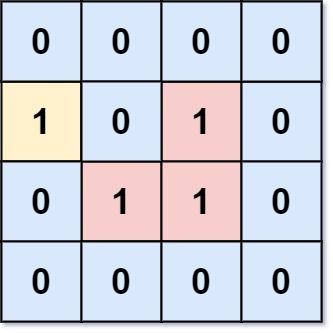
Input: grid = [[0,0,0,0],[1,0,1,0],[0,1,1,0],[0,0,0,0]]
Output: 3
Explanation: There are three 1s that are enclosed by 0s, and one 1 that is not enclosed because its on the boundary.
Example 2:
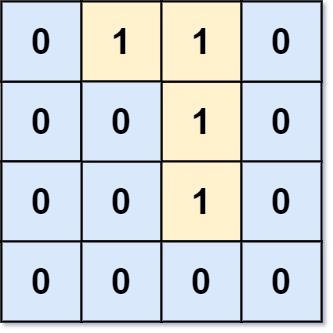
Input: grid = [[0,1,1,0],[0,0,1,0],[0,0,1,0],[0,0,0,0]]
Output: 0
Explanation: All 1s are either on the boundary or can reach the boundary.
Constraints:
m == grid.lengthn == grid[i].length1 <= m, n <= 500grid[i][j] is either 0 or 1. Solutions Solution 1 Thinking
Testing whether each land cell can reach the border repeats searches over the same grid; \(m,n\le 500\) makes that wasteful. Enclaves are land that cannot reach the border, so they are the complement of border-connected land.
Flooding from every \(1\) on the four borders removes all land that can leave. The remaining ones cannot.
DFS performs the flood; the answer is the number of \(1\) s left.
Python3 Java C++ Go TypeScript Rust
 1
 2
 3
 4
 5
 6
 7
 8
 9
10
11
12
13
14
15
16
17
18
19
20
21
22
class Solution :
def numEnclaves ( self , grid : List [ List [ int ]]) -> int :
def dfs ( i : int , j : int ):
grid [ i ][ j ] = 0
for a , b in pairwise ( dirs ):
x , y = i + a , j + b
if 0 <= x < m and 0 <= y < n and grid [ x ][ y ]:
dfs ( x , y )
m , n = len ( grid ), len ( grid [ 0 ])
dirs = ( - 1 , 0 , 1 , 0 , - 1 )
for j in range ( n ):
if grid [ 0 ][ j ]:
dfs ( 0 , j )
if grid [ m - 1 ][ j ]:
dfs ( m - 1 , j )
for i in range ( m ):
if grid [ i ][ 0 ]:
dfs ( i , 0 )
if grid [ i ][ n - 1 ]:
dfs ( i , n - 1 )
return sum ( sum ( row ) for row in grid )
 1
 2
 3
 4
 5
 6
 7
 8
 9
10
11
12
13
14
15
16
17
18
19
20
21
22
23
24
25
26
27
28
29
30
31
32
33
34
35
36
37
38
39
40
41
42
class Solution {
private int [][] grid ;
public int numEnclaves ( int [][] grid ) {
this . grid = grid ;
int m = grid . length , n = grid [ 0 ] . length ;
for ( int j = 0 ; j < n ; j ++ ) {
if ( grid [ 0 ][ j ] == 1 ) {
dfs ( 0 , j );
}
if ( grid [ m - 1 ][ j ] == 1 ) {
dfs ( m - 1 , j );
}
}
for ( int i = 0 ; i < m ; i ++ ) {
if ( grid [ i ][ 0 ] == 1 ) {
dfs ( i , 0 );
}
if ( grid [ i ][ n - 1 ] == 1 ) {
dfs ( i , n - 1 );
}
}
int ans = 0 ;
for ( var row : grid ) {
for ( int x : row ) {
ans += x ;
}
}
return ans ;
}
private void dfs ( int i , int j ) {
grid [ i ][ j ] = 0 ;
final int [] dirs = { - 1 , 0 , 1 , 0 , - 1 };
for ( int k = 0 ; k < 4 ; k ++ ) {
int x = i + dirs [ k ] , y = j + dirs [ k + 1 ] ;
if ( x >= 0 && x < grid . length && y >= 0 && y < grid [ 0 ] . length && grid [ x ][ y ] == 1 ) {
dfs ( x , y );
}
}
}
}
 1
 2
 3
 4
 5
 6
 7
 8
 9
10
11
12
13
14
15
16
17
18
19
20
21
22
23
24
25
26
27
28
29
30
class Solution {
public :
int numEnclaves ( vector < vector < int >>& grid ) {
int m = grid . size (), n = grid [ 0 ]. size ();
int dirs [ 5 ] = { -1 , 0 , 1 , 0 , -1 };
function < void ( int , int ) > dfs = [ & ]( int i , int j ) {
grid [ i ][ j ] = 0 ;
for ( int k = 0 ; k < 4 ; ++ k ) {
int x = i + dirs [ k ], y = j + dirs [ k + 1 ];
if ( x >= 0 && x < m && y >= 0 && y < n && grid [ x ][ y ]) {
dfs ( x , y );
}
}
};
for ( int i = 0 ; i < m ; ++ i ) {
for ( int j = 0 ; j < n ; ++ j ) {
if ( grid [ i ][ j ] && ( i == 0 || i == m - 1 || j == 0 || j == n - 1 )) {
dfs ( i , j );
}
}
}
int ans = 0 ;
for ( auto & row : grid ) {
for ( auto & v : row ) {
ans += v ;
}
}
return ans ;
}
};
 1
 2
 3
 4
 5
 6
 7
 8
 9
10
11
12
13
14
15
16
17
18
19
20
21
22
23
24
25
26
27
func numEnclaves ( grid [][] int ) ( ans int ) {
m , n := len ( grid ), len ( grid [ 0 ])
dirs := [ 5 ] int { - 1 , 0 , 1 , 0 , - 1 }
var dfs func ( i , j int )
dfs = func ( i , j int ) {
grid [ i ][ j ] = 0
for k := 0 ; k < 4 ; k ++ {
x , y := i + dirs [ k ], j + dirs [ k + 1 ]
if x >= 0 && x < m && y >= 0 && y < n && grid [ x ][ y ] == 1 {
dfs ( x , y )
}
}
}
for i , row := range grid {
for j , v := range row {
if v == 1 && ( i == 0 || i == m - 1 || j == 0 || j == n - 1 ) {
dfs ( i , j )
}
}
}
for _ , row := range grid {
for _ , v := range row {
ans += v
}
}
return
}
 1
 2
 3
 4
 5
 6
 7
 8
 9
10
11
12
13
14
15
16
17
18
19
20
21
22
23
24
25
26
27
28
29
function numEnclaves ( grid : number [][]) : number {
const m = grid . length ;
const n = grid [ 0 ]. length ;
const dirs = [ - 1 , 0 , 1 , 0 , - 1 ];
const dfs = ( i : number , j : number ) => {
grid [ i ][ j ] = 0 ;
for ( let k = 0 ; k < 4 ; ++ k ) {
const x = i + dirs [ k ];
const y = j + dirs [ k + 1 ];
if ( x >= 0 && x < m && y >= 0 && y <= n && grid [ x ][ y ] === 1 ) {
dfs ( x , y );
}
}
};
for ( let i = 0 ; i < m ; ++ i ) {
for ( let j = 0 ; j < n ; ++ j ) {
if ( grid [ i ][ j ] === 1 && ( i === 0 || i === m - 1 || j === 0 || j === n - 1 )) {
dfs ( i , j );
}
}
}
let ans = 0 ;
for ( const row of grid ) {
for ( const v of row ) {
ans += v ;
}
}
return ans ;
}
 1
 2
 3
 4
 5
 6
 7
 8
 9
10
11
12
13
14
15
16
17
18
19
20
21
22
23
24
25
26
27
28
29
30
31
32
33
34
35
36
37
impl Solution {
fn dfs ( grid : & mut Vec < Vec < i32 >> , y : usize , x : usize ) {
if y >= grid . len () || x >= grid [ 0 ]. len () || grid [ y ][ x ] == 0 {
return ;
}
grid [ y ][ x ] = 0 ;
Solution :: dfs ( grid , y + 1 , x );
Solution :: dfs ( grid , y , x + 1 );
if y != 0 {
Solution :: dfs ( grid , y - 1 , x );
}
if x != 0 {
Solution :: dfs ( grid , y , x - 1 );
}
}
pub fn num_enclaves ( mut grid : Vec < Vec < i32 >> ) -> i32 {
let mut res = 0 ;
let m = grid . len ();
let n = grid [ 0 ]. len ();
for i in 0 .. m {
Solution :: dfs ( & mut grid , i , 0 );
Solution :: dfs ( & mut grid , i , n - 1 );
}
for i in 0 .. n {
Solution :: dfs ( & mut grid , 0 , i );
Solution :: dfs ( & mut grid , m - 1 , i );
}
for i in 1 .. m - 1 {
for j in 1 .. n - 1 {
if grid [ i ][ j ] == 1 {
res += 1 ;
}
}
}
res
}
}
Solution 2 Thinking
DFS may recurse on the order of \(2.5\times 10^5\) cells. Connectivity does not depend on search order.
A queue of border land cells runs the same flood in BFS, clearing reachable cells and counting what remains.
Python3 Java C++ Go TypeScript
 1
 2
 3
 4
 5
 6
 7
 8
 9
10
11
12
13
14
15
16
17
18
class Solution :
def numEnclaves ( self , grid : List [ List [ int ]]) -> int :
m , n = len ( grid ), len ( grid [ 0 ])
q = deque ()
for i in range ( m ):
for j in range ( n ):
if grid [ i ][ j ] and ( i == 0 or i == m - 1 or j == 0 or j == n - 1 ):
q . append (( i , j ))
grid [ i ][ j ] = 0
dirs = ( - 1 , 0 , 1 , 0 , - 1 )
while q :
i , j = q . popleft ()
for a , b in pairwise ( dirs ):
x , y = i + a , j + b
if x >= 0 and x < m and y >= 0 and y < n and grid [ x ][ y ]:
q . append (( x , y ))
grid [ x ][ y ] = 0
return sum ( v for row in grid for v in row )
 1
 2
 3
 4
 5
 6
 7
 8
 9
10
11
12
13
14
15
16
17
18
19
20
21
22
23
24
25
26
27
28
29
30
31
32
33
class Solution {
public int numEnclaves ( int [][] grid ) {
int m = grid . length ;
int n = grid [ 0 ] . length ;
Deque < int []> q = new ArrayDeque <> ();
for ( int i = 0 ; i < m ; ++ i ) {
for ( int j = 0 ; j < n ; ++ j ) {
if ( grid [ i ][ j ] == 1 && ( i == 0 || i == m - 1 || j == 0 || j == n - 1 )) {
q . offer ( new int [] { i , j });
grid [ i ][ j ] = 0 ;
}
}
}
int [] dirs = { - 1 , 0 , 1 , 0 , - 1 };
while ( ! q . isEmpty ()) {
var p = q . poll ();
for ( int k = 0 ; k < 4 ; ++ k ) {
int x = p [ 0 ] + dirs [ k ] , y = p [ 1 ] + dirs [ k + 1 ] ;
if ( x >= 0 && x < m && y >= 0 && y < n && grid [ x ][ y ] == 1 ) {
q . offer ( new int [] { x , y });
grid [ x ][ y ] = 0 ;
}
}
}
int ans = 0 ;
for ( var row : grid ) {
for ( var v : row ) {
ans += v ;
}
}
return ans ;
}
}
 1
 2
 3
 4
 5
 6
 7
 8
 9
10
11
12
13
14
15
16
17
18
19
20
21
22
23
24
25
26
27
28
29
30
31
32
33
34
class Solution {
public :
int numEnclaves ( vector < vector < int >>& grid ) {
int m = grid . size (), n = grid [ 0 ]. size ();
int dirs [ 5 ] = { -1 , 0 , 1 , 0 , -1 };
queue < pair < int , int >> q ;
for ( int i = 0 ; i < m ; ++ i ) {
for ( int j = 0 ; j < n ; ++ j ) {
if ( grid [ i ][ j ] && ( i == 0 || i == m - 1 || j == 0 || j == n - 1 )) {
q . emplace ( i , j );
grid [ i ][ j ] = 0 ;
}
}
}
while ( ! q . empty ()) {
auto [ i , j ] = q . front ();
q . pop ();
for ( int k = 0 ; k < 4 ; ++ k ) {
int x = i + dirs [ k ], y = j + dirs [ k + 1 ];
if ( x >= 0 && x < m && y >= 0 && y < n && grid [ x ][ y ]) {
q . emplace ( x , y );
grid [ x ][ y ] = 0 ;
}
}
}
int ans = 0 ;
for ( auto & row : grid ) {
for ( auto & v : row ) {
ans += v ;
}
}
return ans ;
}
};
 1
 2
 3
 4
 5
 6
 7
 8
 9
10
11
12
13
14
15
16
17
18
19
20
21
22
23
24
25
26
27
28
29
30
func numEnclaves ( grid [][] int ) ( ans int ) {
m , n := len ( grid ), len ( grid [ 0 ])
dirs := [ 5 ] int { - 1 , 0 , 1 , 0 , - 1 }
q := [][ 2 ] int {}
for i , row := range grid {
for j , v := range row {
if v == 1 && ( i == 0 || i == m - 1 || j == 0 || j == n - 1 ) {
q = append ( q , [ 2 ] int { i , j })
grid [ i ][ j ] = 0
}
}
}
for len ( q ) > 0 {
p := q [ 0 ]
q = q [ 1 :]
for k := 0 ; k < 4 ; k ++ {
x , y := p [ 0 ] + dirs [ k ], p [ 1 ] + dirs [ k + 1 ]
if x >= 0 && x < m && y >= 0 && y < n && grid [ x ][ y ] == 1 {
q = append ( q , [ 2 ] int { x , y })
grid [ x ][ y ] = 0
}
}
}
for _ , row := range grid {
for _ , v := range row {
ans += v
}
}
return
}
 1
 2
 3
 4
 5
 6
 7
 8
 9
10
11
12
13
14
15
16
17
18
19
20
21
22
23
24
25
26
27
28
29
30
31
32
function numEnclaves ( grid : number [][]) : number {
const m = grid . length ;
const n = grid [ 0 ]. length ;
const dirs = [ - 1 , 0 , 1 , 0 , - 1 ];
const q : number [][] = [];
for ( let i = 0 ; i < m ; ++ i ) {
for ( let j = 0 ; j < n ; ++ j ) {
if ( grid [ i ][ j ] === 1 && ( i === 0 || i === m - 1 || j === 0 || j === n - 1 )) {
q . push ([ i , j ]);
grid [ i ][ j ] = 0 ;
}
}
}
while ( q . length ) {
const [ i , j ] = q . shift () ! ;
for ( let k = 0 ; k < 4 ; ++ k ) {
const x = i + dirs [ k ];
const y = j + dirs [ k + 1 ];
if ( x >= 0 && x < m && y >= 0 && y <= n && grid [ x ][ y ] === 1 ) {
q . push ([ x , y ]);
grid [ x ][ y ] = 0 ;
}
}
}
let ans = 0 ;
for ( const row of grid ) {
for ( const v of row ) {
ans += v ;
}
}
return ans ;
}
Solution 3 Thinking
Search still uses a stack or queue proportional to the component size. The same connectivity can be recorded with union-find: adjacent land is united, and every border land is united with a dummy exterior node.
Cells that stay land and are not in the exterior component are enclaves, so we count those sizes.
Python3 Java C++ Go
 1
 2
 3
 4
 5
 6
 7
 8
 9
10
11
12
13
14
15
16
17
18
19
20
21
22
23
24
25
26
27
28
29
30
31
32
33
34
35
36
37
38
39
40
41
class UnionFind :
def __init__ ( self , n ):
self . p = list ( range ( n ))
self . size = [ 1 ] * n
def find ( self , x ):
if self . p [ x ] != x :
self . p [ x ] = self . find ( self . p [ x ])
return self . p [ x ]
def union ( self , a , b ):
pa , pb = self . find ( a ), self . find ( b )
if pa != pb :
if self . size [ pa ] > self . size [ pb ]:
self . p [ pb ] = pa
self . size [ pa ] += self . size [ pb ]
else :
self . p [ pa ] = pb
self . size [ pb ] += self . size [ pa ]
class Solution :
def numEnclaves ( self , grid : List [ List [ int ]]) -> int :
m , n = len ( grid ), len ( grid [ 0 ])
uf = UnionFind ( m * n + 1 )
dirs = ( - 1 , 0 , 1 , 0 , - 1 )
for i , row in enumerate ( grid ):
for j , v in enumerate ( row ):
if v :
if i == 0 or i == m - 1 or j == 0 or j == n - 1 :
uf . union ( i * n + j , m * n )
else :
for a , b in pairwise ( dirs ):
x , y = i + a , j + b
if x >= 0 and x < m and y >= 0 and y < n and grid [ x ][ y ]:
uf . union ( i * n + j , x * n + y )
return sum (
grid [ i ][ j ] == 1 and uf . find ( i * n + j ) != uf . find ( m * n )
for i in range ( m )
for j in range ( n )
)
 1
 2
 3
 4
 5
 6
 7
 8
 9
10
11
12
13
14
15
16
17
18
19
20
21
22
23
24
25
26
27
28
29
30
31
32
33
34
35
36
37
38
39
40
41
42
43
44
45
46
47
48
49
50
51
52
53
54
55
56
57
58
59
60
61
62
63
64
65
66
67
class UnionFind {
private int [] p ;
private int [] size ;
public UnionFind ( int n ) {
p = new int [ n ] ;
size = new int [ n ] ;
for ( int i = 0 ; i < n ; ++ i ) {
p [ i ] = i ;
size [ i ] = 1 ;
}
}
public int find ( int x ) {
if ( p [ x ] != x ) {
p [ x ] = find ( p [ x ] );
}
return p [ x ] ;
}
public void union ( int a , int b ) {
int pa = find ( a ), pb = find ( b );
if ( pa != pb ) {
if ( size [ pa ] > size [ pb ] ) {
p [ pb ] = pa ;
size [ pa ] += size [ pb ] ;
} else {
p [ pa ] = pb ;
size [ pb ] += size [ pa ] ;
}
}
}
}
class Solution {
public int numEnclaves ( int [][] grid ) {
int m = grid . length ;
int n = grid [ 0 ] . length ;
UnionFind uf = new UnionFind ( m * n + 1 );
int [] dirs = { - 1 , 0 , 1 , 0 , - 1 };
for ( int i = 0 ; i < m ; ++ i ) {
for ( int j = 0 ; j < n ; ++ j ) {
if ( grid [ i ][ j ] == 1 ) {
if ( i == 0 || i == m - 1 || j == 0 || j == n - 1 ) {
uf . union ( i * n + j , m * n );
} else {
for ( int k = 0 ; k < 4 ; ++ k ) {
int x = i + dirs [ k ] , y = j + dirs [ k + 1 ] ;
if ( x >= 0 && x < m && y >= 0 && y < n && grid [ x ][ y ] == 1 ) {
uf . union ( i * n + j , x * n + y );
}
}
}
}
}
}
int ans = 0 ;
for ( int i = 1 ; i < m - 1 ; ++ i ) {
for ( int j = 1 ; j < n - 1 ; ++ j ) {
if ( grid [ i ][ j ] == 1 && uf . find ( i * n + j ) != uf . find ( m * n )) {
++ ans ;
}
}
}
return ans ;
}
}
 1
 2
 3
 4
 5
 6
 7
 8
 9
10
11
12
13
14
15
16
17
18
19
20
21
22
23
24
25
26
27
28
29
30
31
32
33
34
35
36
37
38
39
40
41
42
43
44
45
46
47
48
49
50
51
52
53
54
55
56
57
58
59
60
61
62
63
class UnionFind {
public :
UnionFind ( int n ) {
p = vector < int > ( n );
size = vector < int > ( n , 1 );
iota ( p . begin (), p . end (), 0 );
}
void unite ( int a , int b ) {
int pa = find ( a ), pb = find ( b );
if ( pa != pb ) {
if ( size [ pa ] > size [ pb ]) {
p [ pb ] = pa ;
size [ pa ] += size [ pb ];
} else {
p [ pa ] = pb ;
size [ pb ] += size [ pa ];
}
}
}
int find ( int x ) {
if ( p [ x ] != x ) {
p [ x ] = find ( p [ x ]);
}
return p [ x ];
}
private :
vector < int > p , size ;
};
class Solution {
public :
int numEnclaves ( vector < vector < int >>& grid ) {
int m = grid . size (), n = grid [ 0 ]. size ();
UnionFind uf ( m * n + 1 );
int dirs [ 5 ] = { -1 , 0 , 1 , 0 , -1 };
for ( int i = 0 ; i < m ; ++ i ) {
for ( int j = 0 ; j < n ; ++ j ) {
if ( grid [ i ][ j ] == 1 ) {
if ( i == 0 || i == m - 1 || j == 0 || j == n - 1 ) {
uf . unite ( i * n + j , m * n );
} else {
for ( int k = 0 ; k < 4 ; ++ k ) {
int x = i + dirs [ k ], y = j + dirs [ k + 1 ];
if ( x >= 0 && x < m && y >= 0 && y < n && grid [ x ][ y ] == 1 ) {
uf . unite ( i * n + j , x * n + y );
}
}
}
}
}
}
int ans = 0 ;
for ( int i = 1 ; i < m - 1 ; ++ i ) {
for ( int j = 1 ; j < n - 1 ; ++ j ) {
ans += grid [ i ][ j ] == 1 && uf . find ( i * n + j ) != uf . find ( m * n );
}
}
return ans ;
}
};
 1
 2
 3
 4
 5
 6
 7
 8
 9
10
11
12
13
14
15
16
17
18
19
20
21
22
23
24
25
26
27
28
29
30
31
32
33
34
35
36
37
38
39
40
41
42
43
44
45
46
47
48
49
50
51
52
53
54
55
56
57
58
59
60
61
62
63
type unionFind struct {
p , size [] int
}
func newUnionFind ( n int ) * unionFind {
p := make ([] int , n )
size := make ([] int , n )
for i := range p {
p [ i ] = i
size [ i ] = 1
}
return & unionFind { p , size }
}
func ( uf * unionFind ) find ( x int ) int {
if uf . p [ x ] != x {
uf . p [ x ] = uf . find ( uf . p [ x ])
}
return uf . p [ x ]
}
func ( uf * unionFind ) union ( a , b int ) {
pa , pb := uf . find ( a ), uf . find ( b )
if pa != pb {
if uf . size [ pa ] > uf . size [ pb ] {
uf . p [ pb ] = pa
uf . size [ pa ] += uf . size [ pb ]
} else {
uf . p [ pa ] = pb
uf . size [ pb ] += uf . size [ pa ]
}
}
}
func numEnclaves ( grid [][] int ) ( ans int ) {
m , n := len ( grid ), len ( grid [ 0 ])
uf := newUnionFind ( m * n + 1 )
dirs := [ 5 ] int { - 1 , 0 , 1 , 0 , - 1 }
for i , row := range grid {
for j , v := range row {
if v == 1 {
if i == 0 || i == m - 1 || j == 0 || j == n - 1 {
uf . union ( i * n + j , m * n )
} else {
for k := 0 ; k < 4 ; k ++ {
x , y := i + dirs [ k ], j + dirs [ k + 1 ]
if x >= 0 && x < m && y >= 0 && y < n && grid [ x ][ y ] == 1 {
uf . union ( i * n + j , x * n + y )
}
}
}
}
}
}
for i , row := range grid {
for j , v := range row {
if v == 1 && uf . find ( i * n + j ) != uf . find ( m * n ) {
ans ++
}
}
}
return
}