Skip to content

101. Symmetric Tree

Description

Given the root of a binary tree, check whether it is a mirror of itself (i.e., symmetric around its center).


Example 1:

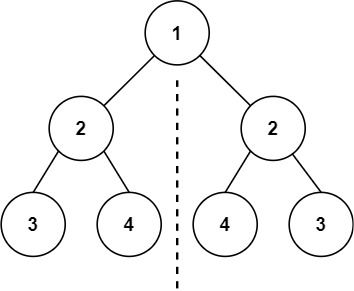
Input: root = [1,2,2,3,4,4,3]
Output: true

Example 2:

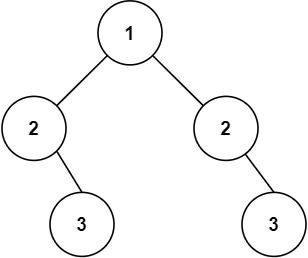
Input: root = [1,2,2,null,3,null,3]
Output: false


Constraints:

  • The number of nodes in the tree is in the range [1, 1000].
  • -100 <= Node.val <= 100


Follow up: Could you solve it both recursively and iteratively?

Solutions

Solution 1: Recursion

Thinking

Symmetry means the left subtree mirrors the right, not that each subtree matches itself. The follow-up asks for both recursion and iteration; \(n \le 1000\), so one pass is enough.

A pair of nodes is symmetric iff their values match and the left child of one mirrors the right child of the other (and vice versa). We therefore start from the root's two children and recurse crosswise.

We design a function \(\textit{dfs}(\textit{root1}, \textit{root2})\) to determine whether two binary trees are symmetric. The answer is \(\textit{dfs}(\textit{root.left}, \textit{root.right})\).

The logic of the function \(\textit{dfs}(\textit{root1}, \textit{root2})\) is as follows:

  • If both \(\textit{root1}\) and \(\textit{root2}\) are null, the two binary trees are symmetric, and we return true;
  • If only one of \(\textit{root1}\) and \(\textit{root2}\) is null, or \(\textit{root1.val} \neq \textit{root2.val}\), we return false;
  • Otherwise, we check whether the left subtree of \(\textit{root1}\) is symmetric with the right subtree of \(\textit{root2}\), and whether the right subtree of \(\textit{root1}\) is symmetric with the left subtree of \(\textit{root2}\), using recursion.

The time complexity is \(O(n)\), and the space complexity is \(O(n)\). Here, \(n\) is the number of nodes in the binary tree.

 1
 2
 3
 4
 5
 6
 7
 8
 9
10
11
12
13
14
15
16
# Definition for a binary tree node.
# class TreeNode:
#     def __init__(self, val=0, left=None, right=None):
#         self.val = val
#         self.left = left
#         self.right = right
class Solution:
    def isSymmetric(self, root: Optional[TreeNode]) -> bool:
        def dfs(root1: Optional[TreeNode], root2: Optional[TreeNode]) -> bool:
            if root1 == root2:
                return True
            if root1 is None or root2 is None or root1.val != root2.val:
                return False
            return dfs(root1.left, root2.right) and dfs(root1.right, root2.left)

        return dfs(root.left, root.right)
 1
 2
 3
 4
 5
 6
 7
 8
 9
10
11
12
13
14
15
16
17
18
19
20
21
22
23
24
25
26
27
28
29
30
/**
 * Definition for a binary tree node.
 * public class TreeNode {
 *     int val;
 *     TreeNode left;
 *     TreeNode right;
 *     TreeNode() {}
 *     TreeNode(int val) { this.val = val; }
 *     TreeNode(int val, TreeNode left, TreeNode right) {
 *         this.val = val;
 *         this.left = left;
 *         this.right = right;
 *     }
 * }
 */
class Solution {
    public boolean isSymmetric(TreeNode root) {
        return dfs(root.left, root.right);
    }

    private boolean dfs(TreeNode root1, TreeNode root2) {
        if (root1 == root2) {
            return true;
        }
        if (root1 == null || root2 == null || root1.val != root2.val) {
            return false;
        }
        return dfs(root1.left, root2.right) && dfs(root1.right, root2.left);
    }
}
 1
 2
 3
 4
 5
 6
 7
 8
 9
10
11
12
13
14
15
16
17
18
19
20
21
22
23
24
25
26
/**
 * Definition for a binary tree node.
 * struct TreeNode {
 *     int val;
 *     TreeNode *left;
 *     TreeNode *right;
 *     TreeNode() : val(0), left(nullptr), right(nullptr) {}
 *     TreeNode(int x) : val(x), left(nullptr), right(nullptr) {}
 *     TreeNode(int x, TreeNode *left, TreeNode *right) : val(x), left(left), right(right) {}
 * };
 */
class Solution {
public:
    bool isSymmetric(TreeNode* root) {
        auto dfs = [&](this auto&& dfs, TreeNode* root1, TreeNode* root2) -> bool {
            if (root1 == root2) {
                return true;
            }
            if (!root1 || !root2 || root1->val != root2->val) {
                return false;
            }
            return dfs(root1->left, root2->right) && dfs(root1->right, root2->left);
        };
        return dfs(root->left, root->right);
    }
};
 1
 2
 3
 4
 5
 6
 7
 8
 9
10
11
12
13
14
15
16
17
18
19
20
21
/**
 * Definition for a binary tree node.
 * type TreeNode struct {
 *     Val int
 *     Left *TreeNode
 *     Right *TreeNode
 * }
 */
func isSymmetric(root *TreeNode) bool {
    var dfs func(root1, root2 *TreeNode) bool
    dfs = func(root1, root2 *TreeNode) bool {
        if root1 == root2 {
            return true
        }
        if root1 == nil || root2 == nil || root1.Val != root2.Val {
            return false
        }
        return dfs(root1.Left, root2.Right) && dfs(root1.Right, root2.Left)
    }
    return dfs(root.Left, root.Right)
}
 1
 2
 3
 4
 5
 6
 7
 8
 9
10
11
12
13
14
15
16
17
18
19
20
21
22
23
24
25
26
/**
 * Definition for a binary tree node.
 * class TreeNode {
 *     val: number
 *     left: TreeNode | null
 *     right: TreeNode | null
 *     constructor(val?: number, left?: TreeNode | null, right?: TreeNode | null) {
 *         this.val = (val===undefined ? 0 : val)
 *         this.left = (left===undefined ? null : left)
 *         this.right = (right===undefined ? null : right)
 *     }
 * }
 */

function isSymmetric(root: TreeNode | null): boolean {
    const dfs = (root1: TreeNode | null, root2: TreeNode | null): boolean => {
        if (root1 === root2) {
            return true;
        }
        if (!root1 || !root2 || root1.val !== root2.val) {
            return false;
        }
        return dfs(root1.left, root2.right) && dfs(root1.right, root2.left);
    };
    return dfs(root.left, root.right);
}
 1
 2
 3
 4
 5
 6
 7
 8
 9
10
11
12
13
14
15
16
17
18
19
20
21
22
23
24
25
26
27
28
29
30
31
32
33
34
35
36
37
38
39
40
41
42
// Definition for a binary tree node.
// #[derive(Debug, PartialEq, Eq)]
// pub struct TreeNode {
//   pub val: i32,
//   pub left: Option<Rc<RefCell<TreeNode>>>,
//   pub right: Option<Rc<RefCell<TreeNode>>>,
// }
//
// impl TreeNode {
//   #[inline]
//   pub fn new(val: i32) -> Self {
//     TreeNode {
//       val,
//       left: None,
//       right: None
//     }
//   }
// }
use std::cell::RefCell;
use std::rc::Rc;
impl Solution {
    pub fn is_symmetric(root: Option<Rc<RefCell<TreeNode>>>) -> bool {
        fn dfs(root1: Option<Rc<RefCell<TreeNode>>>, root2: Option<Rc<RefCell<TreeNode>>>) -> bool {
            match (root1, root2) {
                (Some(node1), Some(node2)) => {
                    let node1 = node1.borrow();
                    let node2 = node2.borrow();
                    node1.val == node2.val
                        && dfs(node1.left.clone(), node2.right.clone())
                        && dfs(node1.right.clone(), node2.left.clone())
                }
                (None, None) => true,
                _ => false,
            }
        }

        match root {
            Some(root) => dfs(root.borrow().left.clone(), root.borrow().right.clone()),
            None => true,
        }
    }
}
 1
 2
 3
 4
 5
 6
 7
 8
 9
10
11
12
13
14
15
16
17
18
19
20
21
22
23
24
/**
 * Definition for a binary tree node.
 * function TreeNode(val, left, right) {
 *     this.val = (val===undefined ? 0 : val)
 *     this.left = (left===undefined ? null : left)
 *     this.right = (right===undefined ? null : right)
 * }
 */
/**
 * @param {TreeNode} root
 * @return {boolean}
 */
var isSymmetric = function (root) {
    const dfs = (root1, root2) => {
        if (root1 === root2) {
            return true;
        }
        if (!root1 || !root2 || root1.val !== root2.val) {
            return false;
        }
        return dfs(root1.left, root2.right) && dfs(root1.right, root2.left);
    };
    return dfs(root.left, root.right);
};

Comments