Skip to content

1008. Construct Binary Search Tree from Preorder Traversal

Description

Given an array of integers preorder, which represents the preorder traversal of a BST (i.e., binary search tree), construct the tree and return its root.

It is guaranteed that there is always possible to find a binary search tree with the given requirements for the given test cases.

A binary search tree is a binary tree where for every node, any descendant of Node.left has a value strictly less than Node.val, and any descendant of Node.right has a value strictly greater than Node.val.

A preorder traversal of a binary tree displays the value of the node first, then traverses Node.left, then traverses Node.right.


Example 1:

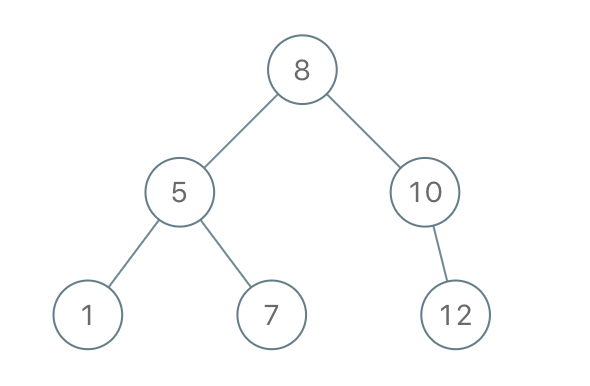
Input: preorder = [8,5,1,7,10,12]
Output: [8,5,10,1,7,null,12]

Example 2:

Input: preorder = [1,3]
Output: [1,null,3]


Constraints:

  • 1 <= preorder.length <= 100
  • 1 <= preorder[i] <= 1000
  • All the values of preorder are unique.

Solutions

Thinking

The first preorder value is the root; a linear scan finds the first larger key and splits the left and right subtrees. \(n\le 100\) makes \(O(n^2)\) acceptable, yet each split walks the same ranges again.

A BST preorder segment still has every left-subtree key below the root and every right-subtree key above it, so the first index greater than the root can be found by binary search.

\(\textit{dfs}(i,j)\) builds a node from \(\textit{preorder}[i]\), bisects to the right-subtree start, and recurses on both sides in \(O(n\log n)\).

We design a function \(\textit{dfs}(i, j)\) to construct a binary search tree from the nodes \(\textit{preorder}[i]\) to \(\textit{preorder}[j]\). The answer is \(\textit{dfs}(0, n - 1)\).

In \(\textit{dfs}(i, j)\), we first construct the root node, which is \(\textit{preorder}[i]\). Then, we use binary search to find the first node greater than \(\textit{preorder}[i]\) and get its index \(\textit{mid}\). We set \(\textit{dfs}(i + 1, \textit{mid} - 1)\) as the left subtree of the root node and \(\textit{dfs}(\textit{mid}, j)\) as the right subtree of the root node.

Finally, we return the root node.

The time complexity is \(O(n \times \log n)\), and the space complexity is \(O(n)\). Here, \(n\) is the length of the array \(\textit{preorder}\).

 1
 2
 3
 4
 5
 6
 7
 8
 9
10
11
12
13
14
15
16
17
18
class Solution:
    def bstFromPreorder(self, preorder: List[int]) -> Optional[TreeNode]:
        def dfs(i: int, j: int) -> Optional[TreeNode]:
            if i > j:
                return None
            root = TreeNode(preorder[i])
            l, r = i + 1, j + 1
            while l < r:
                mid = (l + r) >> 1
                if preorder[mid] > preorder[i]:
                    r = mid
                else:
                    l = mid + 1
            root.left = dfs(i + 1, l - 1)
            root.right = dfs(l, j)
            return root

        return dfs(0, len(preorder) - 1)
 1
 2
 3
 4
 5
 6
 7
 8
 9
10
11
12
13
14
15
16
17
18
19
20
21
22
23
24
25
26
27
28
29
30
31
32
33
34
35
36
37
38
39
40
41
42
/**
 * Definition for a binary tree node.
 * public class TreeNode {
 *     int val;
 *     TreeNode left;
 *     TreeNode right;
 *     TreeNode() {}
 *     TreeNode(int val) { this.val = val; }
 *     TreeNode(int val, TreeNode left, TreeNode right) {
 *         this.val = val;
 *         this.left = left;
 *         this.right = right;
 *     }
 * }
 */
class Solution {
    private int[] preorder;

    public TreeNode bstFromPreorder(int[] preorder) {
        this.preorder = preorder;
        return dfs(0, preorder.length - 1);
    }

    private TreeNode dfs(int i, int j) {
        if (i > j) {
            return null;
        }
        TreeNode root = new TreeNode(preorder[i]);
        int l = i + 1, r = j + 1;
        while (l < r) {
            int mid = (l + r) >> 1;
            if (preorder[mid] > preorder[i]) {
                r = mid;
            } else {
                l = mid + 1;
            }
        }
        root.left = dfs(i + 1, l - 1);
        root.right = dfs(l, j);
        return root;
    }
}
 1
 2
 3
 4
 5
 6
 7
 8
 9
10
11
12
13
14
15
16
17
18
19
20
21
22
23
24
25
26
27
28
29
30
31
32
33
34
35
/**
 * Definition for a binary tree node.
 * struct TreeNode {
 *     int val;
 *     TreeNode *left;
 *     TreeNode *right;
 *     TreeNode() : val(0), left(nullptr), right(nullptr) {}
 *     TreeNode(int x) : val(x), left(nullptr), right(nullptr) {}
 *     TreeNode(int x, TreeNode *left, TreeNode *right) : val(x), left(left), right(right) {}
 * };
 */
class Solution {
public:
    TreeNode* bstFromPreorder(vector<int>& preorder) {
        auto dfs = [&](this auto&& dfs, int i, int j) -> TreeNode* {
            if (i > j) {
                return nullptr;
            }
            TreeNode* root = new TreeNode(preorder[i]);
            int l = i + 1, r = j + 1;
            while (l < r) {
                int mid = (l + r) >> 1;
                if (preorder[mid] > preorder[i]) {
                    r = mid;
                } else {
                    l = mid + 1;
                }
            }
            root->left = dfs(i + 1, l - 1);
            root->right = dfs(l, j);
            return root;
        };
        return dfs(0, preorder.size() - 1);
    }
};
 1
 2
 3
 4
 5
 6
 7
 8
 9
10
11
12
13
14
15
16
17
18
19
20
21
22
23
24
25
26
27
28
29
30
/**
 * Definition for a binary tree node.
 * type TreeNode struct {
 *     Val int
 *     Left *TreeNode
 *     Right *TreeNode
 * }
 */
func bstFromPreorder(preorder []int) *TreeNode {
    var dfs func(i, j int) *TreeNode
    dfs = func(i, j int) *TreeNode {
        if i > j {
            return nil
        }
        root := &TreeNode{Val: preorder[i]}
        l, r := i+1, j+1
        for l < r {
            mid := (l + r) >> 1
            if preorder[mid] > preorder[i] {
                r = mid
            } else {
                l = mid + 1
            }
        }
        root.Left = dfs(i+1, l-1)
        root.Right = dfs(l, j)
        return root
    }
    return dfs(0, len(preorder)-1)
}
 1
 2
 3
 4
 5
 6
 7
 8
 9
10
11
12
13
14
15
16
17
18
19
20
21
22
23
24
25
26
27
28
29
30
31
32
33
34
35
/**
 * Definition for a binary tree node.
 * class TreeNode {
 *     val: number
 *     left: TreeNode | null
 *     right: TreeNode | null
 *     constructor(val?: number, left?: TreeNode | null, right?: TreeNode | null) {
 *         this.val = (val===undefined ? 0 : val)
 *         this.left = (left===undefined ? null : left)
 *         this.right = (right===undefined ? null : right)
 *     }
 * }
 */

function bstFromPreorder(preorder: number[]): TreeNode | null {
    const dfs = (i: number, j: number): TreeNode | null => {
        if (i > j) {
            return null;
        }
        const root = new TreeNode(preorder[i]);
        let [l, r] = [i + 1, j + 1];
        while (l < r) {
            const mid = (l + r) >> 1;
            if (preorder[mid] > preorder[i]) {
                r = mid;
            } else {
                l = mid + 1;
            }
        }
        root.left = dfs(i + 1, l - 1);
        root.right = dfs(l, j);
        return root;
    };
    return dfs(0, preorder.length - 1);
}
 1
 2
 3
 4
 5
 6
 7
 8
 9
10
11
12
13
14
15
16
17
18
19
20
21
22
23
24
25
26
27
28
29
30
31
32
33
34
35
36
37
38
39
40
41
42
43
44
45
46
// Definition for a binary tree node.
// #[derive(Debug, PartialEq, Eq)]
// pub struct TreeNode {
//   pub val: i32,
//   pub left: Option<Rc<RefCell<TreeNode>>>,
//   pub right: Option<Rc<RefCell<TreeNode>>>,
// }
//
// impl TreeNode {
//   #[inline]
//   pub fn new(val: i32) -> Self {
//     TreeNode {
//       val,
//       left: None,
//       right: None
//     }
//   }
// }
use std::cell::RefCell;
use std::rc::Rc;
impl Solution {
    pub fn bst_from_preorder(preorder: Vec<i32>) -> Option<Rc<RefCell<TreeNode>>> {
        fn dfs(preorder: &Vec<i32>, i: usize, j: usize) -> Option<Rc<RefCell<TreeNode>>> {
            if i > j {
                return None;
            }
            let root = Rc::new(RefCell::new(TreeNode::new(preorder[i])));
            let mut l = i + 1;
            let mut r = j + 1;
            while l < r {
                let mid = (l + r) >> 1;
                if preorder[mid] > preorder[i] {
                    r = mid;
                } else {
                    l = mid + 1;
                }
            }
            let mut root_ref = root.borrow_mut();
            root_ref.left = dfs(preorder, i + 1, l - 1);
            root_ref.right = dfs(preorder, l, j);
            Some(root.clone())
        }

        dfs(&preorder, 0, preorder.len() - 1)
    }
}

Comments